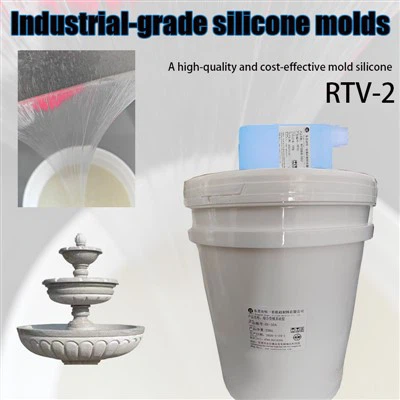
What are the differences between industrial-level and manual-level?
If you have used a small electronic scale in the kitchen to mix and pour the handcrafted glue, you might think that silicone is just "mixing and pouring". But for industrial-grade mold silicone, it faces a completely different world:
·Output and stability: Handmade glue may tolerate a slight uneven mixture once, but in industry, a single batch may contain 25 kilograms of glue. The batch stability must be highly consistent; any slight deviation would result in the entire batch being scrapped.
·Mechanical resistance: It's not just for molding a few plaster dolls. Industrial-grade silicone must withstand the high-temperature heat release of polyurethane resin, the alkaline erosion of concrete, the styrene attack of unsaturated resin, and even the temperature shock of low-melting-point alloys.
·Precision control: A 1% shrinkage in handwork may not be noticeable, but in the mold-making process of industrial components, excessive shrinkage means assembly failure.
Lifespan requirements: A high-quality industrial mold is expected to be able to be demolded hundreds or even thousands of times, and it should not tear or deform during the process.
Therefore, understanding industrial-grade silicone rubber essentially means understanding its physical property parameters.
Interpreting the "identity card" of industrial silica gel: Core physical indicators
When you receive a technical data sheet, you don't need to be a chemist, but you must understand the following several indicators.
1. Viscosity - Determines how you operate
Viscosity is expressed in cps or mPa·s. The lower the value, the better the fluidity.
·Low viscosity (8000 - 15000 cps): Like syrup, it flows extremely fast. Suitable for pouring precise and complex prototypes. Bubbles are easily expelled and vacuum or non-vacuum pouring can be achieved.
·Medium viscosity (20000 - 40000 cps): Like honey. The most common range, suitable for most pouring molds and medium-sized brush molds.
· High viscosity/ thixotropic (thixotropic paste): Does not flow or does not scrape and flow. Suitable for brush molding processes on vertical surfaces, ceilings or large sculptures. It can adhere to thickness and does not run.
2. Hardness - Determines the ease of demolding and the mold's supportability
It is usually expressed by Shore A scale, with higher numbers indicating greater hardness.
Shore A 5-10 (Super Soft): Extremely flexible, suitable for molding extremely complex and decorated components with a large number of inverted designs, such as elaborate European carvings. When demolding, the mold can be flipped over, but the support is poor, and large pieces may deform.
Shore A 15-20 (Medium Soft, Golden Range): The most balanced choice. It has sufficient support, can maintain geometric accuracy, and has enough elasticity to allow resin or cement pieces with fine inverted designs to be smoothly removed. Most industrial sculptures and craft ornaments use this range.
·Shore A 25-35 (Slightly Hard): Suitable for flat pieces or geometric shapes with simple structures, no inverted designs, and the pursuit of absolute size accuracy. It has good support for heavy materials such as gypsum and concrete, but as the hardness increases, the tear strength may be sacrificed. Be aware of the tear values on the TDS.
3. Tensile strength and tear strength - These determine how long the mold can last.
4. These are two concepts that are often confused but are actually completely different.
5. Tensile strength: The force required to break the silicone. It reflects the inherent toughness of the material.
6. Tear strength: This is the lifespan indicator that industrial molders are most concerned about. It refers to the ability of the silicone to resist further cracking once there is a small crack. During demolding, the edges of the mold often get torn. A high tear strength (typically above 20 kN/m is considered excellent) can ensure that your mold is resistant to tearing and ripping, and the edges will not easily crack. If you want to mold polyurethane or resin, be sure to choose the brand with a high tear value.
7. 4. Operating time and curing time - These determine your working pace.
8. Industrial silicone gel is usually calibrated under a standard environment of 20-25℃.
9. Operation time: After mixing, you will have a sufficient time window for pouring, brushing, and vacuuming. In summer, when the workshop is hot, the operation time will be significantly shortened. For large-scale operations, it is recommended to choose the model with a longer operation time or use a small amount of retardant.
10. Curing time: The time when it reaches complete elasticity and can be demolded. At room temperature, it usually takes 2-4 hours.
11. 5. Shrinkage rate - Determines the accuracy of dimensions
12. For condensation-type (tin-cured) silicone, the shrinkage rate is generally around 0.3%-0.5%. If you want to replicate the product prototype for size verification, be sure to choose platinum silicone.
13. Condensation type vs. Addition type: An industrial choice question
14. Industrial-grade silicone molds mainly have two chemical reaction systems. Which one to choose depends on your application environment.
15. Condensation type silicone (tin catalysis)
16. Advantages: Strong resistance to inhibitors, insensitive to resin, gypsum, cement, wood and other model surfaces, rarely occurs poisoning without curing. Economical price.
17. Limitations: Slightly higher shrinkage rate, slow deep curing, possible oil leakage after a long time.
18. Applicable: Cement structures, sandstone relief, gypsum lines, wax molds, less demanding resin handicrafts.
19. Room temperature curing silicone (platinum catalysis)
20. Advantages: Extremely precise dimensions, zero shrinkage, high temperature resistance (can withstand above 200℃, can pour low melting point alloys), food grade, uniform curing without by-products.
21. Limitations: Very sensitive. Once it comes into contact with substances containing sulfur, tin, amine, incompletely cured unsaturated resins, poisoning will occur, the surface will become sticky and unable to cure. The price is usually 1.5-2 times that of condensation type.
22. Applicable: Action figures and precision models, precision casting wax molds, alloys with high temperature requirements, food grade molds, production lines requiring ultra-long life and high precision.
23. Industrial-grade Application Scenarios and Selection Quick Reference
24. Architectural decoration (GRC components, cultural stones): Requires high alkali resistance. Recommended is the condensation type silicone, with hardness ranging from A25 to A30, high tear strength. It can be diluted with silicone oil to reduce costs and reinforced with glass fiber cloth.
25. Bathroom fixtures (artificial stone bathtubs, sinks): The molds are usually large. Use the condensation type silicone combined with thixotropic thickening, adopt the brush molding process, and combine the inner and outer layers of the rubber, with the outer layer attached to the fiberglass mold.
26. Prototype of automotive parts / small batch production: Needs to be resistant to polyurethane at high temperatures and has high dimensional accuracy requirements. Condensation-type silica gel, with hardness ranging from A25 to A35, vacuum casting.
27. From the Laboratory to the Workshop: Industrial Discipline in Operations
28. In industry, mistakes cost hundreds of times more than in manual work. Please remember these golden rules:
29. 1. The accuracy of the mixture is sacred. Most industrial silicone resins are mixed by weight, such as 100A:2B. An accurately calibrated electronic scale must be used, with an error control within ±0.5%. Stirring must involve scraping the walls and the bottom, lasting for 3-5 minutes to ensure there are no stripes.
30. 2. Vacuum degassing is not an optional process. The workshop must be equipped with a vacuum degassing machine.
31. 3. The prototype must be completely sealed or use a release agent. For porous models (such as gypsum, wood), they must be thoroughly sealed with a sealing agent (such as shellac, polyurethane varnish) before drying, and then apply a release agent.
32. 4. Post-curing enhances performance. After room temperature curing, do not rush to put it into production immediately. It can significantly stabilize physical properties, eliminate internal stress, and extend the service life.
33. The selection of industrial-grade silicone for molds essentially involves finding the best balance among precision, durability, cost, and process convenience. It is not merely about purchasing a bucket of silicone, but rather about acquiring an entire system that guarantees production efficiency and product quality.
34. If you are planning a new mold production line, or if you wish to enhance the durability and accuracy of your current molds, our engineering team is willing to recommend proven adhesive solutions based on your prototype material and production requirements.
Hot Tags: understanding the parameters is the key to truly mastering adhesive selection., China understanding the parameters is the key to truly mastering adhesive selection. manufacturers, suppliers, factory