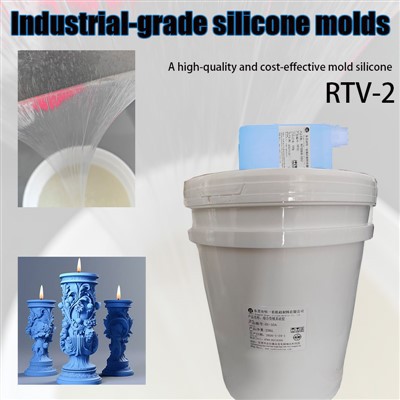
What is condensing type mold silicone?
In simple terms, the condensation type moldable silicone is a thermosetting elastomer that cures at room temperature. Unlike the industrial adhesives we are familiar with, it is specifically designed to replicate the textures of building surfaces. It flows like a liquid, is as flexible as rubber, and has extremely excellent demolding properties.
Why do builders tend to prefer the "condensation type"?
In the production of GRC (glass fiber reinforced concrete), cement components and plaster lines, the materials must withstand alkaline environments and physical stretching. The condensation type silicone rubber has the following characteristics, making it a "evergreen" product in the field of building molds:
1. Excellent cost-effectiveness: Compared to the molding silicone, the condensation silicone offers a higher cost-performance ratio while meeting the production requirements of building components. For production lines with a large number of mold changes, this means lower initial investment.
2. Outstanding fluidity: Even for molds with European-style patterns or complex textures, the condensation silicone can fill every tiny gap without any dead corners, ensuring the clarity of the texture reaches the micron level.
3. Chemical resistance and low shrinkage rate: It can well withstand the alkaline corrosion of cement and concrete, and the shrinkage rate after curing is extremely low (usually within 0.2%), ensuring that the size of each component produced in batches is uniformly standard.
How to use it correctly in a construction project?
If this is your first time encountering this material, here is a "guide to avoiding pitfalls", which is also the practical experience we often share with our clients:
· Stirring is crucial: The silicone and the curing agent (usually 2%-3%) must be thoroughly mixed evenly. If there are unmixed ingredients on the container walls, it will lead to incomplete curing in some areas, causing your mold to fail.
· Vacuum degassing: This is very important. Construction molds are often large in size. If air bubbles are incorporated during the mixing process, these bubbles will form "explosion lines" when the cement is poured, affecting the appearance. It is recommended to use a vacuum machine to extract the bubbles or to extend the degassing time by reducing the proportion of the curing agent.
· Strength support: Since construction components often have a heavy weight, the flexibility of the silicone alone is not sufficient. We suggest making a fiberglass or gypsum outer mold around the silicone mold as a support to keep the mold from deforming during the pouring process.
Common Misconception: How is it different from the addition process?
Many purchasers will ask: "Should I go for the more expensive injection molding?" It depends on your product.
· Condensation type: Suitable for common handicrafts and components such as cement, gypsum, and resins. It has relatively loose requirements for the operating environment and has sufficient tear resistance to meet most demolding needs.
· Injection type: More suitable for precision parts, food-grade models, or scenarios with extremely high transparency requirements.
In the field of construction, condensation type materials have always been the preferred choice due to their excellent resistance to acids and alkalis as well as ease of operation.
Under the trend of building industrialization, having a durable and highly precise silicone mold means having the confidence for efficient production. Our condensation type silicone molds have been widely used in the production of imitation stone materials, cultural stone molds, and large Roman columns.
Hot Tags: why is condensation type mold silicone the ideal choice for concrete art?, China why is condensation type mold silicone the ideal choice for concrete art? manufacturers, suppliers, factory