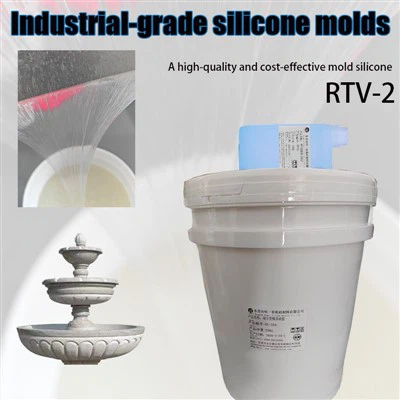
The coefficient of thermal expansion (CTE) is a crucial property when it comes to materials used in ancient architecture, especially silicone. As a leading supplier of Ancient architecture silicone, understanding the CTE of our products is essential for ensuring the long - term stability and integrity of ancient architectural structures.
Understanding the Coefficient of Thermal Expansion
The coefficient of thermal expansion is defined as the fractional change in length or volume of a material per degree change in temperature. Mathematically, for linear expansion, the formula is $\alpha=\frac{\Delta L}{L_0\Delta T}$, where $\alpha$ is the linear coefficient of thermal expansion, $\Delta L$ is the change in length, $L_0$ is the original length, and $\Delta T$ is the change in temperature. For volumetric expansion, the volumetric coefficient of thermal expansion $\beta$ is related to the linear coefficient by $\beta = 3\alpha$ for isotropic materials.


In the context of ancient architecture, the CTE of silicone plays a vital role. Ancient buildings often have unique structures and historical significance. Any material used for restoration or preservation needs to have a CTE that is compatible with the existing building materials. If the CTE of the silicone is too different from that of the surrounding materials, it can lead to stress and cracking over time due to temperature variations.
Factors Affecting the CTE of Ancient Architecture Silicone
The CTE of silicone can be influenced by several factors. Firstly, the chemical composition of the silicone is a major determinant. Different types of silicones, such as addition - cured and condensation - cured silicones, have different CTE values. Addition - cured silicones generally have a more uniform molecular structure, which can result in a relatively lower and more predictable CTE. Condensation - cured silicones, on the other hand, may have a slightly higher CTE due to the presence of by - products during the curing process.
The filler materials added to the silicone also impact the CTE. Fillers can be used to modify the physical properties of the silicone, including its thermal expansion characteristics. For example, adding silica fillers can reduce the CTE of the silicone, making it more stable under temperature changes.
The curing conditions during the production of the silicone also matter. The temperature, humidity, and curing time can all affect the final molecular structure of the silicone, which in turn influences its CTE. If the curing process is not carefully controlled, it can lead to variations in the CTE of the silicone product.
Importance of CTE in Ancient Architecture
In ancient architecture, maintaining the structural integrity is of utmost importance. The CTE of the silicone used in restoration or preservation work must be carefully considered. For instance, when using silicone to seal joints in ancient stone buildings, a silicone with a similar CTE to the stone is required. If the silicone expands or contracts at a different rate than the stone, it can cause the seal to break, allowing moisture to penetrate and damage the structure.
In addition, for decorative elements in ancient architecture, such as glassware molds made with silicone, the CTE is crucial. If the CTE of the silicone is not appropriate, it can lead to distortion of the glassware during the cooling process. This is why we offer Silicone used for making glassware molds, which is formulated to have a CTE that is compatible with the glass - making process.
CTE in Different Applications of Ancient Architecture Silicone
Large - scale Stone Buildings
For large - scale stone buildings, the silicone used must have a CTE that matches the stone as closely as possible. Our Silicone For Large - scale Stone Buildings is designed to meet this requirement. It can withstand the temperature variations that these buildings experience over time, ensuring a long - lasting and effective seal. The silicone forms a flexible yet durable bond with the stone, preventing water infiltration and protecting the building from weathering.
Decorative Elements
In the creation of decorative elements in ancient architecture, such as candles with unique designs, the CTE of the silicone used for molds is critical. Our Condensation Mold Silicone Inks For Veitnam Candles is formulated to have a CTE that allows for accurate replication of the mold design. This ensures that the candles produced have the desired shape and details, even after the cooling process.
Measuring the CTE of Ancient Architecture Silicone
To accurately measure the CTE of our silicone products, we use advanced testing equipment. One common method is the dilatometry technique. In this method, a sample of the silicone is heated or cooled at a controlled rate, and the change in length is measured using a dilatometer. The data obtained from these measurements is then used to calculate the CTE.
We also conduct long - term monitoring of our silicone products in real - world conditions. By installing sensors in ancient buildings where our silicone is used, we can track the expansion and contraction of the silicone over time. This helps us to verify the accuracy of our CTE measurements and make any necessary adjustments to our product formulations.
Our Commitment as a Supplier
As a supplier of Ancient architecture silicone, we are committed to providing high - quality products with well - defined CTE values. Our research and development team continuously works on improving the thermal properties of our silicones. We conduct extensive testing to ensure that our products meet the strict requirements of ancient architecture restoration and preservation.
We understand that each ancient building is unique, and we offer customized solutions based on the specific needs of our customers. Whether it is a small - scale restoration project or a large - scale preservation effort, we have the expertise and products to meet the challenges.
Contact for Purchase and Consultation
If you are involved in an ancient architecture project and are in need of high - quality silicone with the appropriate CTE, we invite you to contact us for a consultation. Our team of experts can provide you with detailed information about our products and help you select the most suitable silicone for your project. We look forward to working with you to preserve and restore the beauty of ancient architecture.
References
- ASTM E831 - 14, Standard Test Method for Linear Thermal Expansion of Solid Materials by Thermomechanical Analysis.
- "Silicone Elastomers: Science and Technology" by Clive L. Lee and Andrew H. Markham.
- Research papers on the use of silicone in ancient architecture restoration from leading academic journals in the field of heritage conservation.