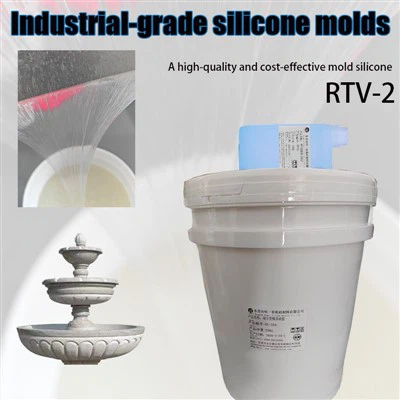
As an industrial grade silicone supplier, I'm often asked about the production process of industrial grade silicone. In this blog, I'll take you through the detailed steps of how industrial grade silicone is produced, from the raw materials to the finished product.
1. Raw Materials
The primary raw material for industrial grade silicone is silicon, which is abundant in the Earth's crust, usually in the form of silica (SiO₂). Silica can be sourced from quartz sand, which is widely available. To obtain silicon, silica is first reduced with carbon in an electric arc furnace at high temperatures (around 1,800 - 2,000°C). This process results in the production of metallurgical - grade silicon.
However, for industrial grade silicone, a higher purity of silicon is required. Metallurgical - grade silicon is further refined through a series of chemical processes. One common method is the Siemens process, where silicon reacts with hydrogen chloride (HCl) to form trichlorosilane (SiHCl₃). Trichlorosilane is then purified by distillation to remove impurities such as boron, phosphorus, and other metals. Finally, the purified trichlorosilane is reduced with hydrogen to produce high - purity polycrystalline silicon.
2. Synthesis of Siloxane Monomers
Once high - purity silicon is obtained, it is used to synthesize siloxane monomers, which are the building blocks of silicone polymers. The most common method for this synthesis is the direct process.
In the direct process, silicon reacts with methyl chloride (CH₃Cl) in the presence of a copper catalyst at a temperature of about 250 - 300°C. This reaction produces a mixture of methylchlorosilanes, such as dimethyldichlorosilane ((CH₃)₂SiCl₂), which is the most important monomer for industrial grade silicone production.
The reaction can be represented by the following equation:
Si + 2CH₃Cl → (CH₃)₂SiCl₂
The mixture of methylchlorosilanes is then separated by fractional distillation based on their different boiling points. Dimethyldichlorosilane is the key intermediate as it can be readily hydrolyzed to form siloxane oligomers.
3. Hydrolysis and Condensation
Dimethyldichlorosilane undergoes hydrolysis when it reacts with water. During hydrolysis, the chlorine atoms in dimethyldichlorosilane are replaced by hydroxyl groups (-OH), resulting in the formation of silanols. The reaction is as follows:
(CH₃)₂SiCl₂ + 2H₂O → (CH₃)₂Si(OH)₂ + 2HCl
The silanols then undergo a condensation reaction. In this process, the hydroxyl groups react with each other, eliminating water molecules and forming siloxane bonds (-Si - O - Si -). This leads to the formation of linear or cyclic siloxane oligomers. Depending on the reaction conditions, such as the concentration of reactants, temperature, and the presence of catalysts, the degree of polymerization can be controlled.
4. Polymerization
The siloxane oligomers obtained from the hydrolysis and condensation step are further polymerized to form high - molecular - weight silicone polymers. This can be achieved through two main methods: anionic polymerization and cationic polymerization.
Anionic Polymerization:
In anionic polymerization, a strong base such as potassium hydroxide (KOH) is used as a catalyst. The base initiates the opening of the siloxane ring in the cyclic oligomers, and the reaction propagates as the growing polymer chain adds more siloxane units. Anionic polymerization allows for good control of the molecular weight and molecular weight distribution of the silicone polymer.
Cationic Polymerization:
Cationic polymerization, on the other hand, uses a Lewis acid catalyst such as sulfuric acid (H₂SO₄) or trifluoromethanesulfonic acid (CF₃SO₃H). The catalyst activates the siloxane bonds, enabling the addition of siloxane units to the growing polymer chain. Cationic polymerization is often used for the production of silicones with specific functional groups or structures.
5. Functionalization and Modification
Industrial grade silicone can be further functionalized and modified to meet different application requirements. For example, by incorporating functional groups such as vinyl, phenyl, or fluoroalkyl groups into the silicone polymer chain, the properties of the silicone can be altered.
Vinyl - functionalized silicones are commonly used in addition - curing systems, where they can react with hydrosilane cross - linkers in the presence of a platinum catalyst to form a three - dimensional network structure. This results in silicone materials with excellent mechanical properties, high temperature resistance, and chemical stability.


Phenyl - containing silicones have improved thermal stability and UV resistance, making them suitable for applications in high - temperature environments or outdoor applications. Fluoroalkyl - functionalized silicones have low surface energy and excellent water - and oil - repellency, which are useful in applications such as coatings and lubricants.
6. Blending and Compound Formulation
After the polymerization and functionalization steps, the silicone polymers are often blended with other additives to form compound formulations. These additives can include fillers, plasticizers, pigments, and curing agents.
Fillers:
Fillers are used to improve the mechanical properties of the silicone, such as tensile strength, tear resistance, and hardness. Common fillers include fumed silica, precipitated silica, and calcium carbonate. Fumed silica is particularly effective in reinforcing silicone polymers due to its high surface area and good dispersion characteristics.
Plasticizers:
Plasticizers are added to improve the flexibility and processability of the silicone. They can lower the glass transition temperature of the silicone polymer, allowing it to be more easily molded and shaped.
Pigments:
Pigments are used to give the silicone a desired color. They can be organic or inorganic pigments, depending on the application requirements.
Curing Agents:
Curing agents are essential for cross - linking the silicone polymer chains and transforming the silicone compound into a solid, durable material. The choice of curing agent depends on the type of silicone and the curing mechanism. For example, in addition - curing systems, hydrosilane cross - linkers and platinum catalysts are used, while in condensation - curing systems, organotin catalysts and silane cross - linkers are used. You can learn more about how to add the curing agent to ensure a long service life of silicone rubber from this How Should The Curing Agent Be Added To Ensure That The Silicone Rubber Has A Long Service Life?.
7. Processing and Shaping
Once the silicone compound is formulated, it can be processed into various shapes and forms using different manufacturing techniques. Some common processing methods include:
Molding:
Molding is a widely used method for producing industrial grade silicone products. There are different types of molding processes, such as injection molding, compression molding, and transfer molding. In injection molding, the silicone compound is heated and injected into a mold cavity under high pressure. The mold is then cooled, and the silicone part is ejected. Compression molding involves placing a pre - measured amount of silicone compound in a heated mold cavity and applying pressure to form the part. Transfer molding is a combination of injection molding and compression molding, where the silicone compound is first heated in a transfer chamber and then forced into the mold cavity. You can explore more about industrial - grade silicone for molds here Industrial - grade Silicone For Molds.
Extrusion:
Extrusion is used to produce continuous silicone profiles, such as tubes, rods, and seals. In the extrusion process, the silicone compound is fed into an extruder, where it is heated and forced through a die under pressure. The die determines the cross - sectional shape of the extruded product.
Casting:
Casting is suitable for producing large or complex - shaped silicone parts. In casting, the liquid silicone compound is poured into a mold and allowed to cure at room temperature or under controlled heating conditions.
8. Quality Control and Testing
Throughout the production process, strict quality control measures are implemented to ensure that the industrial grade silicone products meet the required standards and specifications. Quality control tests can include:
Chemical Analysis:
Chemical analysis is used to determine the composition and purity of the silicone, including the content of various elements, functional groups, and additives.
Mechanical Testing:
Mechanical testing is performed to evaluate the physical properties of the silicone, such as tensile strength, elongation at break, hardness, and tear resistance.
Thermal Testing:
Thermal testing is used to assess the thermal stability and performance of the silicone at different temperatures. This can include measuring the melting point, glass transition temperature, and thermal expansion coefficient.
Environmental Testing:
Environmental testing is conducted to evaluate the resistance of the silicone to different environmental factors, such as humidity, UV radiation, and chemical exposure.
Conclusion
The production of industrial grade silicone is a complex and multi - step process that involves the use of advanced chemical technologies and manufacturing techniques. From the extraction of raw materials to the finished products, each step requires careful control and quality assurance to ensure the high performance and reliability of the silicone.
If you are looking for high - quality industrial grade silicone products, our company is your reliable partner. We have extensive experience in the production and supply of industrial grade silicone, and we can provide customized solutions to meet your specific needs. Whether you need silicone for molds, such as creating exquisite lotus lantern molds To Create Exquisite Lotus Lantern Molds, Choosing The Right Industrial - grade Mold Silicone Is The Key., or for cultural stone molds to avoid issues like blurry textures and mold blistering Choosing The Wrong Silicone For Cultural Stone Molds Leads To Blurry Textures, Mold Blistering, And Short Lifespan? Try This Industrial - grade Solution., we've got you covered. Don't let the wrong choice of silicone lead to mold production failure The Mold Production Failed. 90% Of The Reason Was That The Wrong Type Of Silicone Was Chosen.. Contact us today to start a discussion about your industrial grade silicone requirements. We look forward to working with you and helping you find the perfect silicone solution for your business.
References
- Mark, J. E., & Bikales, N. M. (Eds.). (1989). Encyclopedia of polymer science and engineering. John Wiley & Sons.
- Ohmura, R. (2007). Silicones: chemistry and technology. Wiley - VCH.
- Schulz, G. V., & Harth, E. (Eds.). (2010). Polymer synthesis: theory and practice. Springer.